INTRODUCTION
This trip report gives details of sightings on a week long holiday based around Fuengirola
in the province of Malaga on the Costa del Sol in mid-September. First and
foremost this wasn't a trip solely to watch birds as I was travelling with three non-birding friends. Sites visited for birds included Doñana
National Park, Gibraltar, and Laguna Fuente de Piedra. Although the breeding season was well over, migration was fairly good at the spots I
was able get to, e.g. Gibraltar. It was still pretty hot at this time of the year, even more so inland away from the cooling effects of the
coastal strip.
HIGHLIGHTS
Black-eared Wheatear · Red-rumped Swallow · Mediterranean Shearwater · Cory's Shearwater · Bee-eater · Chough · Pallid Swift · Melodious
Warbler · Orphean Warbler · Blue Rock Thrush · Lesser Kestrel · Griffon Vulture · Dartford Warbler · Bonelli's Eagle · Audouin's Gull · Egyptian
Vulture · Honey Buzzard · Booted Eagle · Short·toed Eagle · Black Kite · Montagu's Harrier · Hobby · Eleonora's Falcon · White Stork ·
Greater Flamingo · Short-toed Lark · Spectacled Warbler · Collared Pratincole · Hoopoe · Southern Grey Shrike · Cattle Egret · Red-necked
Nightjar · Black-winged Stilt · Avocet · Spanish Imperial Eagle · Savi's Warbler · Azure-winged Magpie.
TRAVEL & ACCOMMODATION
We booked a late package deal through Airtours (including car hire) but did our own thing on arrival in Spain. A buffet breakfast was included
with accommodation and we ate out quite cheaply around Fuengirola or in whatever town in the countryside we happened to be near. The
drawback of stayling in the same locality is the longer driving distances involved but the roads are good provided you stay off the old coast
road along the Costa del Sol.
LITERATURE, REFERENCES & SITE GUIDES USED
1. Garcia, E. & Paterson, A. 1994. Where To Watch Birds in Southern Spain. Helm.
2. Svensson, L. et al. 1999. Bird Guide. HarperCollins.
3. Tolman, T. & Lewington, R. 1997. Butterflies of Britain & Europe. Collins.
ITINERARY
Day 1 12/09/00 Glasgow Airport > Malaga Airport > Benalmadena > Fuengirola.
Day 2 13/09/00 Fuengirola > Sand Pedro > Ronda > Fuengirola.
Day 3 14/09/00 Fuengirola > Mijas > Sierra de Mijas > Fuengirola.
Day 4 15/09/00 Fuengirola > Gibraltar > Fuengirola.
Day 5 16/09/00 Fuengirola > Laguna de Fuente de Piedra > Fuengirola.
Day 6 17/09/00 Fuengirola > Granada > Fuengirola.
Day 7 18/09/00 Fuengirola > Sevilla > Parqu Nacional de Doñana > Fuengirola.
Day 8 19/09/00 Fuengirola > Malaga Airport > Glasgow Airport.
THE DIARY
Sunday 12 September 1999
Glasgow
Airport > Malaga Airport > Benalmadena > Fuengirola
MALAGA AIRPORT 1145h
The car hire collection point (according to a holiday rep) wasn't even in the terminal building and we had to walk through some waste
ground carrying rucksacks and suitcases in stifling heat. We didn't find it and returned to the arrivals hall to be told that it was actually hidden
away there. My three non-birding friends were complaining bitterly. However, I was happy as this first heat endurance test did provide a
migrant immature Black-eared Wheatear on an area of watered lawn with palms - the vegetation everywhere else was parched. Several
Spotless Starlings flying overhead later followed by a Little Egret. Several Pierid butterflies.
BENALMADENA 1259h
Stopped in
the town for a drink at a café. Spotless Starlings fairly common on roofs
around the town. A flock of (8) Cirl Buntings on a dry slope above the town.
Cattle Egret overhead. House Sparrows common. A male Common Tiger Blue (Tarucus balkanicus) fluttered down from
a roadside tree and landed on our table.
FUENGIROLA 1340h
Checked
into the Hotel Torreblanca. From the balcony, fairly high up, 70 Yellow-legged Gulls were visible on the roofs of two nearby hotels. Many
juvenile birds in the flock. House Sparrow common – call noted to be slightly
different to my local birds in Ayrshire, Scotland. Slightly higher pitched and a
different tone. Walked
about 2 miles west along the coast where Yellow-legged Gulls were numerous.
Adult male Red-rumped Swallow flying around gardens and down a side street off
the promenade. Another Common Tiger Blue butterfly observed. White Wagtail in a
dried up river bed.
Monday 13 September 1999
Fuengirola
> San Pedro > Ronda
FUENGIROLA BEACH
0800-0845h.
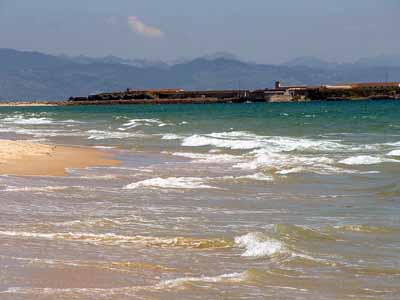
Walked down to the shore shortly after sunrise. Hundreds of shearwaters passing
east along the coastline. The majority were Mediterranean/Balearic Shearwaters
but also good numbers of Cory’s which were flying much closer to the shoreline.
A few Cory’s Shearwaters resting on the calm sea c200 metres offshore. Cattle
Egrets moving west along the coast in large numbers from roost sites to feeding
areas. Groups of up to 10 passing over the town in tight flocks, e.g. 30 in
five minutes. Yellow-legged Gulls numerous. Red-rumped Swallow (2) west along
the coast.
FUENGIROLA > SAN PEDRO >
RONDA
Cattle
Egrets fairly common in agricultural areas and still flying in groups along the
coast. Stopped for petrol on the autovia – a Sardinian Warbler and Stonechat on
the scrubby hillside above the petrol station. Large numbers of hirundines
moving southwest along the coastline. Flock of 12 Grey Herons observed in a
river running under the motorway. Red-rumped Swallow (12) at San Pedro. A few
Buzzards, Kestrels and Goshawks in the hills between San Pedro and Ronda.
Migrating flock of c30 Bee-eaters in the sky above Ronda.
RONDA
Walked
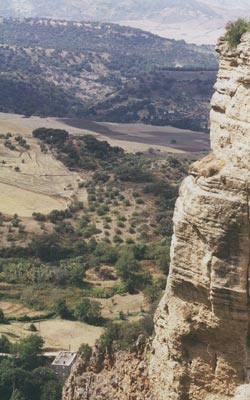
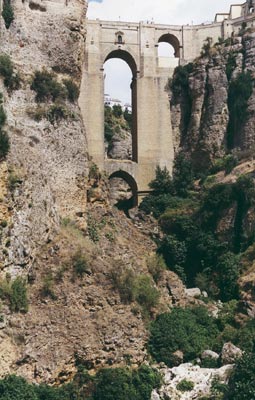
around the city and ended up at the Puente Nuevo bridge over the Tajo gorge where the first good
birds were enjoyed. Numerous Crag Martins along the vertical, precipitous
cliffs in the gorge below. Choughs common on the rocky outcrops – flying over
and under the bridge and tumbling acrobatically more than 50 feet through the
air. Alpine and Pallid Swifts racing through the cleft. Spotless Starlings and
House Sparrows numerous. Several hundred Feral Rock Doves in the area. Walked
down the foot of the gorge providing spectacular views back up to the Puente
Nuevo bridging the geologically divided areas of the city. By this time of the
year the land was parched by the summer sun. The dry, scrubby areas around the
olive groves and agricultural contrasted with the green and luxuriant riverine
growth along the Rio Guadalevin. Large numbers of migrant warblers flitting
around. Melodious Warblers particularly common, also Chiffchaffs and Willow
Warblers. Good views of a Orphean Warbler flitting around the top of a large
fig tree, calling very much like a Blackcap. Several Sardinian Warblers
observed in the riverside scrub. Stonechats common. Barn Swallows hawking over
cereal stubble. Several Blue Rock Thrushes in the wider area with quite a few
identified as juvenile birds. One bird singing from a cliffside location. A
female Lesser Kestrel perched on a small pylon. Very like Common Kestrel but
first check through the scope revealed the claw colour to be very pale. The
moustachial stripe looked less prominent also. Grey and White Wagtails on the
river. A few Rock Sparrows feeding in a very dry field nears the few buildings
here. House Sparrows and Goldfinches were the most numerous species. Barn
Swallow, House Martin and Red-rumped Swallow noted. Serins common, Also Wren,
Blue Tit, Robin, Great Tit and Dunnock. At least 100 Choughs in the sky above
the bridge on returning just before a heavy downpour. At times the whole flock
plummeting down through the gorge, calling loudly and giving an impressive
visual display. Several species of dragonfly noted including Red-veined Darter
(Sympetrum fonscolombei).

Tuesday 14 September 1999
Fuengirola
> Mijas > Sierra de Mijas
FUENGIROLA BEACH
0830-0910h.
Much less visible seabird activity today. A few shearwaters just visible at long range heading east. Yellow-legged
Gull, Black-headed Gull, and Lesser Black-backed Gull noted.
SIERRA DE MIJAS
1300-1815h.
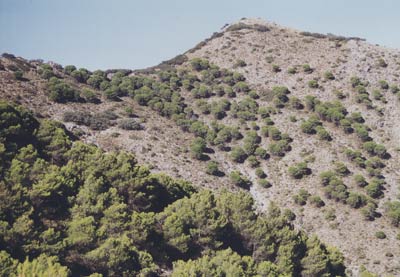
Climbed up from the town through the Mediterranean scrub and pine forests. Pied
Flycatchers very common with migrants almost in small flocks on the lower
slopes.
Striped Grayling (Pseudotergumia
fidia) butterflies basking in the sunshine on rocky outcrops with larger numbers towards the top of the
hill where the pine cover was more sparse. Excellent views of a Griffon Vulture
gliding and soaring in the valley below. Massive broad wings and very long
flight ‘fingers’ immediately apparent. Contrasting brown and black wings and
whitish head. Several Goshawks observed hunting just above the canopy of the
pines. One pair of birds watched pursuing each other over a large area of the
mountainside. Dartford Warblers fairly common with their harsh, churring calls
heard fairly regularly. Coal Tits common. Crested Tits also common with fewer
sightings of Blue and Great Tits. Most noticed on the lower slopes where
several Firecrests were observed within a few metres. Raven and Common Kestrel
regular. Purple-coloured droppings on several outcrops, perhaps from Red-legged
Partridges feeding on berries. Excellent views from the top with visibility for
miles into the valley to the north. Small parties of Crossbills regularly
encountered. Reptiles noted: Iberian Rock Lizard (Lacerta monticola), Turkish Gecko (Hemidactylus turcicus), Eyed Lizard (Lacerta lepida), Psammodromus sp. and an unidentified snake
species. Chough heard calling in the distance. Good, close views of a Bonelli’s
Eagle (mainly from above) gliding along the ridge between neighbouring peaks.
Wings shape immediately distinctive – leading edges very straight but with
obvious carpal projection. Pale/white
back and mantle patch observables with the naked eye, contrasting with the very
dark wings and tail. Speckled Wood noted on the walk back down to the village
if Mijas at 1805h.
FUENGIROLA
Torreblanca
Hotel 1920h. An adult and two juvenile Lesser Kestrels around the tower block hotel. One bird giving
a three note call made up of rough-sounding high pitched notes – very
distinctive compared with the call of Common Kestrel. At least five Red-rumped
Swallows flying around the car park of the hotel. Also several House Martins.
Movement of Cattle Egrets again apparent this evening, flying from feeding
areas to roosting sites. Cicadas singing everywhere at dusk, even in flower
beds and trees along the beach.
Wednesday
15 September 1999
Fuengirola
> Gibraltar
GIBRALTAR
Drove along
the Costa
del Sol to
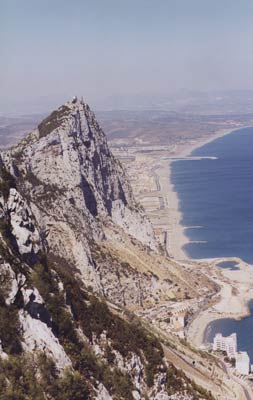
the massive rock looming out of western end of the Mediterranean. Parked the car at La Linea de la
Concepción in Spain
and walked across the airstrip via
the customs gate. Lesser Kestrel (5) soaring together over the town. Two-tailed
Pasha (Charaxes jasius) butterfly
basking in the intensely bright sunshine on a wall at the customs/passport
checkpoint. A group of adult (4) and juvenile (3) Audouin’s Gull picked out
amongst the Yellow-legged Gulls on the rocky shoreline at the frontier. Two
adult Egyptian Vultures observed flapping lazily along the rock above Gibraltar city.
Took the
cable car up to the Upper Rock Nature Reserve to look for visible migration of
soaring raptors. Watching from Jews’ Gate, there was a reasonable westerly wind
but the hot conditions meant that most raptors were passing south across the
straits to North
Africa at
a fair height. Continued up to the highest point (426m) at O’ Hara’s Battery. Not much for the first 30 minutes
except for a few Honey Buzzards but a check of the sky above with the bins
revealed at least 12 Honey Buzzards milling about at a fair height. The
following were note between 1400h and 1600h, leaving mainland Europe: Honey
Buzzard (min. 42), Booted
Eagle (4), Short-toed Eagle (11), Black Kite
(13), Montagu’s
Harrier (5), Common
Buzzard (1), Egyptian
Vulture (9), Sparrowhawk
(1), Hobby (2), Bee-eater
(2). Several
White Storks and good numbers of Common Swifts, Barn Swallows, Sand Martins,
Pallid Swifts and Red-rumped Swallows. Masses of dragonflies and hoverflies hanging
around the rock and plenty of Painted Ladies (Vanessa cardui) and Red Admirals (Vanessa atalanta) around. Migrant Hawkers (Aeshna mixta) and Common Darter (Sympetrum
striolatum) the most abundant species but also many Vagrant Emperors (Hemianax aphippiger).
Great views
of resident Peregrine, Common and Lesser Kestrels. Alpine Swifts feeding at a
fair height over the area. Crag Martins common around the cliffs and steeper
slopes. 
Area known
as the Mediterranean Steps: Sardinian Warblers common in the maquis scrub and
garrigue-covered slopes here. Two-tailed Pashas common, landing on scrub at eye
level. Blackcap, Chaffinch, Serin, Blackbird, Greenfinch, Spotless Starling,
House Sparrow, Blue Tit, Great Tit and Nightingale.
Cable Car
Top Station: Several family groups of Barbary Macaque (Macaca sylvanus) apes stuffing their faces with bananas and other fruits from the tourists. Several
Two-tailed Pashas basking here on the tarmac and on low walls and vegetation.
Numerous hawkers buzzing along the ridge.
Gibraltar
city: Lesser Kestrel, Pallid Swift,
Common Swift, Crag Martin and Yellow-legged Gulls overhead.
GIBRALTAR > FUENGIROLA
Stopped at
Punta de la Chullera near Estepona on the drive back. Eleonora’s
Falcon – an adult flying southwest along the coast about 100 metres from land.
Around Peregrine size but with different proportions. Very long tail and long
wings with lightweight body. Flying a little like a skua but gliding down from
height to low over the sea. Moustachial stripe visible through the scope. Uniform
grey above and brownish below. Black-looking underwing coverts.
Thursday
16 September 1999
Laguna
de Fuente de Piedra, between Antequera and Estepa.
LAGUNA DE FUENTE
DE PIEDRA
1200-2100h.
Got dropped off here with the rest of the guys continuing on to Seville. Clear blue sky and 35°C. Famous
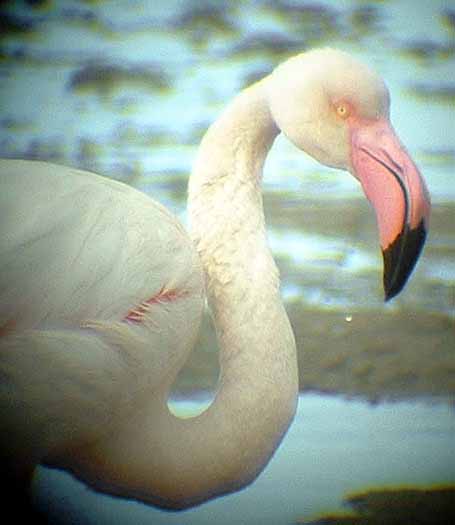
for the largest Greater Flamingo colony in Iberia, this huge, saline lagoon was
almost dried up by this stage of the summer. The area around breeding flamingos
is pumped with water to maintain the right conditions. Surrounded by sunflower
and cereal fields (now mostly ploughed at this time of year), olive groves, and
distant mountains. Still about 100 Greater Flamingos present in an area c1.5 km
from the Cerro del Palo information centre at the village of Fuente de Piedra. About 30 were juvenile birds.
Accompanied by numerous Black-tailed Godwits and Ruff. Marshy area between the
info centre and the village: Black-winged Stilt (62) with 30 juvenile birds.
Good numbers of migrant waders: Ruff, Black-tailed Godwit, Spotted Redshank,
Green Sandpiper, Wood Sandpiper and Little Stint. Also numerous Snipe and
Lapwing. At least 200 Coots and Moorhens, mostly juveniles, feeding in the
pools. Crested Larks relatively common in surrounding dry, stony terrain.
Short-toed Larks less common but still highly visible in the dusty landscape. Many
migrant passerines in the scrub and fields bordering the lake: Northern
Wheatear, Whinchat, Black Redstart, Melodious Warbler, Pied Flycatcher, Spotted
Flycatcher, Common Redstart, Garden Warbler, Barn Swallow and Sand Martin.
Spectacled Warbler found in an area of tamarisks – difficult to get good views
of this skulker. Red-legged Partridge detected in a large olive grove. Three
more birds were accidentally disturbed from the their resting sites in the trees
themselves. House Sparrow, Goldfinch and Serin all common in the groves and
around a few left over seeding sunflowers along the tracks circumnavigating the
lagoon. Kestrel, Collared Dove and Feral Pigeon also noted. Small flock of 12
Yellow Wagtails (flava, iberiae plus unidentified juvs.) feeding
on dry, stony ground in front of the info centre. Dragonflies abundant with the
following identified: Common Darter (S.
striolatum), Red-veined Darter (S.
fonscolombei), Scarlet Darter (Crocothemis
erythraea) and Migrant Hawker (A.
mixta). Swallowtail butterflies common on flowers around the centre
buildings – Papilio machaon and Iphiclides podalirius. Collared
Pratincole (2) observed flying over a sparsely vegetated area of dry land –
graceful and almost tern-like in flight – and briefly landed in a dried out
stream bed/drainage channel. Spotless Starling (147) counted on telegraph wires
on the edge of the village. Hoopoe (ad) feeding in muddy soil on the edge of
the lake, then in a grassy area at the visitor centre. Stonechat (m) in the
quarry (now converted into the car park). Excellent views of a Southern Grey
Shrike perched on a reserve sign. Regularly flying to the ground, picking up
prey before returning to it’s lookout perch. Cattle Egret feeding in long vegetation
around the marsh. Curlew Sandpiper (3) and several Little Ringed Plovers
present at the marsh in the evening. Several bat species appearing around the
visitor after 2050h. Masses of cicadas and crickets singing around 2100h.
Checked the edge of the lake for Stone Curlews after dusk but none seen or
heard – rabbits and hares becoming active.

Friday
17 September 1999
Fuengirola
> Granada
FUENGIROLA
BEACH
0840-0940h.
Good numbers of bird passing southwest along the coast this morning: Mediterranean
Shearwater (1098), Cory’s Shearwater (112), Gannet (36), Kentish Plover (2) and
several Sandwich Terns.
FUENGIROLA
> GRANADA
Not much
seen today. Visited the Alhambra Palace in the city. White Stork overhead
in the Rio Genil valley at Fuensanta. Common and Pallid Swifts over the palace.
Lesser Kestrels observed over the city. A few Black Kites circling around the
edge of Granada. On the drive back a Red-necked Nightjar was found near
Archidona – hawking over stone pine woodland beside the A-359.
Saturday
18 September 1999
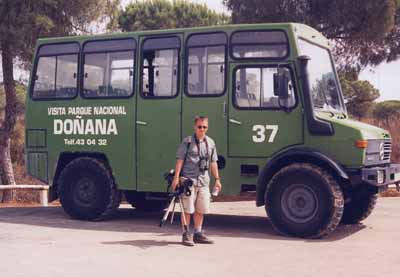
Parque
Nacional de Coto de Doñana, Huelva Province
PARQUE
NACIONAL DE DOÑANA
After a
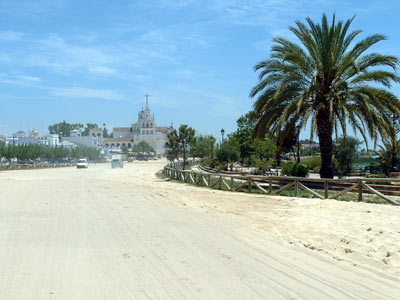
long dry from Fuengirola via Sevilla we finally arrived at El Rocío at 0955h.
Spent a bit of time driving around the ‘wild west’ town and getting stuck in
the sand before realising that the lagoon was right beside the village – or would
have been except that the area was almost completely dry. There were some birds
present but were distant and huddled around the remaining pool of water.
Greater Flamingo (76). Black-winged Stilt (163). Avocet (12). Numerous Greenshank,
Ruff and Black-tailed Godwits. Small numbers of Curlew Sandpipers, Dunlin and Little
Stint. Lapwing. Mallard. Cattle Egret. Hundreds of Yellow Wagtails feeding
around the feet of the horses and cattle in the grazed grassland. Hoopoes
fairly common in the area. Crested Larks very common. Tawny Pipit (1). White
Storks nest on a building on the edge of the village. Greylag Goose (8). Masses
of Barn Swallows and Sand Martins hawking up and down the sandy streets of the
village, particularly in the area in front of the Iglesia de Nuestra Señora del Rocío. Common Kestrel and Grey
Heron overhead. My brother then picked out a huge bird soaring high above.
Turned out to be a Spanish Imperial Eagle.
Brief description: Very large eagle-sized bird with long dark and broad rectangular-shaped
wings narrowing. No barring detected. Long fingered wingtips. Tail fairly short
– dark terminal band contrasting with pale tail base plumage. At certain angles
some pale plumage could be detected on the leading edge of the wings. Observed
for about 15 minutes before it drifted off.
Centro de La
Rocina: Walked around the nature trails and hides overlooking the Charco de la
Boca – again very dry! Little of great interest about with the exception of the
Savi’s Warblers showing well on the edges of the reed and sedge beds. The
surrounding stone pine woodlands held numerous common migrants and residents:
Pied Flycatcher, Redstart, Spotted Flycatcher, Firecrest, Crested Tit, Blue
Tit, Great Tit, Coal Tit, and Short-toed Treecreeper.
El Acebuche:
A few
Southern Grey Shrikes on the wires along the A-483 road from El Rocío to Matalascañas. Crested Larks numerous along
the edge of the road. Immediately on entering the car park of the information
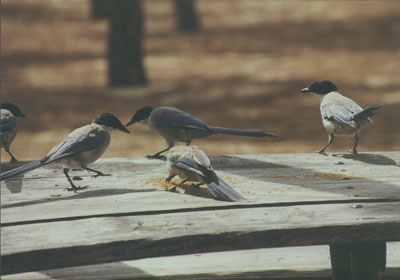
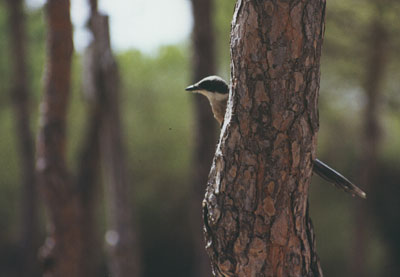
centre several Azure-winged Magpies flew across in front of us and into the
adjacent pines. Flight fluttering and bouncing a bit like a Jay. Stunning
contrast of pale blue wings and tails with grey-brown back and black cap. The
lagoon here was very disappointing with none of the Doñana ‘specialities’ seen
apart from Red-crested Pochard (ad+3 juvs).
Good numbers of Mallard, Coot, Shoveler and Little Grebe. A few Wigeon and
Teal. Green Sandpipers fairly common along the muddy edges of the lagoon. Kingfisher
passed the hide and settled close by on some reeds. Several Grey Herons
passing. Little Egret feeding in shallows just on front of the hide. Group of
10 Ruddy Shelduck (mostly juveniles) present. Large numbers of Barn Swallow,
House Martin and Sand Martin hawking overhead. Back at the picnic tables around
the information centre we watched the Azure-winged Magpies for a while as they
developed an unhealthy appetite for choc-chip cookies. At least 23 birds (mostly
juvs.) visible at one time. The young birds were less confident in approaching
than the adult birds which were fairly tame. Drove along the coast to Matalascañas
before the long drive back to Fuengirola. More Azure-winged Magpie flying over
the road. Several Southern Grey Shrikes on roadside wires.

Sunday
19 September 1999
Fuengirola
> Malaga Airport > Glasgow Airport
Departure day with nothing
of great interest seen on the drive apart from more Cattle Egrets.